Build surface fuel grids from LANDFIRE
You are viewing in-progress documentation for v2. Switch to the stable version for the current production release.
LANDFIRE supplies several categorical descriptions of surface fuels. FastFuels fetches the classification for your domain, then uses that product’s lookup table to produce the continuous load, depth, and surface-area-to-volume bands your workflow needs. Every product follows the same two-step pattern: fetch a classification grid, then run a lookup against it.
Choose a LANDFIRE product
Section titled “Choose a LANDFIRE product”| Product | Use it when you need | Categorical band | Representative lookup output |
|---|---|---|---|
| Annual FBFM40 | Scott and Burgan’s 40 fire-behavior fuel models for a landscape vintage | fbfm | Dead timelag and live herbaceous/woody loads, SAVR, fuel depth |
| Seasonal FBFM40 | A published seasonal condition layer rather than the annual FBFM40 baseline | fbfm | The same FBFM40 parameter vocabulary |
| FBFM13 | Anderson’s 13 fire-behavior fuel models | fbfm13 | Dead timelag and live foliage loads, SAVR, fuel depth |
| FCCS | Fuelbeds with litter, duff, shrub, herb, and woody components | fccs | Litter and duff loads, duff depth, live and dead loads |
These products classify the landscape under different systems. Their numeric codes are identifiers within each system, not interchangeable fuel-load values.
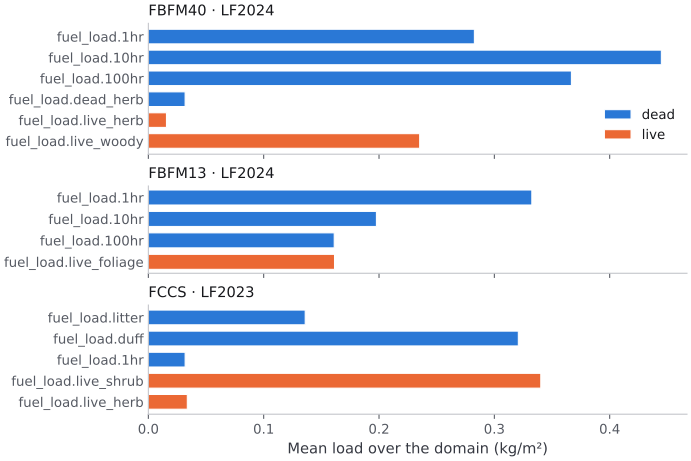
Mean load over the Santa Fe domain of each load band the FBFM40, FBFM13, and
FCCS lookups on this page request. Non-burnable cells count as zero. FBFM13
reports one live class, fuel_load.live_foliage. FCCS reports litter and duff
as separate bands.
Each product is available at one or more LANDFIRE landscape vintages. Some
vintages are served from pre-built national rasters. The current-year vintage is
fetched on demand from the LANDFIRE Product Service (LFPS) and takes longer,
with coverage that varies by region. Not every product has every vintage — FCCS,
for instance, has one pre-built vintage (2023) and the on-demand 2025. The
coverage check at the end of this
guide shows which versions and seasons are available for your domain.
Prerequisites
Section titled “Prerequisites”-
An API key: my-api-key.
-
A domain within LANDFIRE coverage: your-domain-id. See Create a domain.
Build an annual FBFM40 grid
Section titled “Build an annual FBFM40 grid”Fetch the classification
Section titled “Fetch the classification”To replace non-burnable classes, add remove_non_burnable to the request with
a list of codes, such as ["NB1", "NB9"]. Each listed code is replaced with the
most frequent burnable fuel model in its neighborhood.
curl -X 'POST' \ 'https://api.fastfuels.silvxlabs.com/v2/domains/your-domain-id/grids/fbfm40/landfire' \ -H 'accept: application/json' \ -H 'api-key: my-api-key' \ -H 'Content-Type: application/json' \ -d '{ "name": "Annual FBFM40 — LF2024", "version": "2024"}'import fastfuels_sdk.v2 as fffrom fastfuels_sdk.v2.client_library.models import LandfireFbfm40Version
ff.set_api_key("my-api-key")
domain = ff.Domain.from_id("your-domain-id")
annual = ff.grids.create_fuel_model_grid_from_landfire_fbfm40( domain, version=LandfireFbfm40Version("2024"), name="Annual FBFM40 — LF2024",){ "id": "your-fbfm40-grid-id", "domain_id": "your-domain-id", "name": "Annual FBFM40 — LF2024", "description": "", "status": "pending", "progress": null, "created_on": "2026-11-03T16:30:42.502717", "modified_on": "2026-11-03T16:30:42.502717", "checksum": "eb91d64e6ef947478d719689290bfd57", "source": { "name": "landfire", "product": "fbfm40", "version": "2024", "description": "LANDFIRE FBFM40 fuel model codes (Scott-Burgan 40 classification)", "extent_buffer_cells": 0, "alignment": { "target": "domain", "resolution": null, "method": null }, "disturbance": null, "remove_non_burnable": null, "boundary_scatter": null, "season": null, "year": 2024 }, "modifications": [], "bands": [ { "key": "fbfm", "name": "Scott & Burgan 40 Fuel Model", "description": "Scott & Burgan 40 fire behavior fuel model code (e.g. GR1, TL3, SH5). Convert to fuel parameters via /grids/lookup/fbfm40.", "type": "categorical", "unit": null, "index": 0, "nodata": null, "summary": null } ], "georeference": null, "error": null, "chunks": { "shape": [512, 512], "count": null, "count_by_axis": null }, "tags": []}version is the LANDFIRE landscape vintage — the snapshot of the landscape
that LANDFIRE modeled. The response reports the calendar year the data
represents as source.year. For an annual grid the two match. This example
requests LF2024, a pre-built vintage. Record the id as
your-fbfm40-grid-id. Set your-grid-id to that value and
poll until completed:
curl -X 'GET' \ 'https://api.fastfuels.silvxlabs.com/v2/domains/your-domain-id/grids/your-grid-id' \ -H 'accept: application/json' \ -H 'api-key: my-api-key'annual.wait(){ "id": "your-fbfm40-grid-id", "domain_id": "your-domain-id", "name": "Annual FBFM40 — LF2024", "description": "", "status": "completed", "progress": { "percent": 100, "message": "Complete" }, "created_on": "2026-11-03T16:30:42.502717Z", "modified_on": "2026-11-03T16:30:45.407835Z", "checksum": "eb91d64e6ef947478d719689290bfd57", "source": { "disturbance": null, "version": "2024", "name": "landfire", "product": "fbfm40", "description": "LANDFIRE FBFM40 fuel model codes (Scott-Burgan 40 classification)", "extent_buffer_cells": 0, "alignment": { "method": null, "target": "domain", "resolution": null }, "year": 2024, "remove_non_burnable": null, "season": null, "boundary_scatter": null }, "modifications": [], "bands": [ { "key": "fbfm", "name": "Scott & Burgan 40 Fuel Model", "description": "Scott & Burgan 40 fire behavior fuel model code (e.g. GR1, TL3, SH5). Convert to fuel parameters via /grids/lookup/fbfm40.", "type": "categorical", "unit": null, "index": 0, "nodata": 32767, "summary": { "type": "categorical", "count": 11227, "nodata_count": 0, "unique_count": 17 } } ], "georeference": { "crs": "EPSG:32613", "transform": [ 29.92571976224661, 0.0, 416700.0, 0.0, -29.925719762248104, 3948562.3491355116 ], "shape": [103, 109] }, "error": null, "chunks": { "shape": [512, 512], "count": 1, "count_by_axis": { "y": 1, "x": 1 } }, "tags": []}Translate the codes into physical parameters
Section titled “Translate the codes into physical parameters”Point the lookup at the completed FBFM grid. source_band is the band
holding the codes (fbfm), and bands is the list of parameters to compute.
curl -X 'POST' \ 'https://api.fastfuels.silvxlabs.com/v2/domains/your-domain-id/grids/lookup/fbfm40' \ -H 'accept: application/json' \ -H 'api-key: my-api-key' \ -H 'Content-Type: application/json' \ -d '{ "name": "Annual FBFM40 surface parameters", "source_grid_id": "your-fbfm40-grid-id", "source_band": "fbfm", "bands": [ "fuel_load.1hr", "fuel_load.10hr", "fuel_load.100hr", "fuel_load.dead_herb", "fuel_load.live_herb", "fuel_load.live_woody", "fuel_depth" ]}'annual_fuel = ff.grids.create_fuel_grid_from_fbfm40_lookup( annual, bands=[ "fuel_load.1hr", "fuel_load.10hr", "fuel_load.100hr", "fuel_load.dead_herb", "fuel_load.live_herb", "fuel_load.live_woody", "fuel_depth", ], name="Annual FBFM40 surface parameters",)annual_fuel.wait(){ "id": "your-lookup-grid-id", "domain_id": "your-domain-id", "name": "Annual FBFM40 surface parameters", "description": "", "status": "pending", "progress": null, "created_on": "2026-11-03T16:30:47.902692", "modified_on": "2026-11-03T16:30:47.902692", "checksum": "70f1eafcfe164fb2b164a65e03494c31", "source": { "name": "lookup", "table": "fbfm40", "source_grid_id": "your-fbfm40-grid-id", "source_grid_checksum": "eb91d64e6ef947478d719689290bfd57", "source_band": "fbfm", "herbaceous_curing": 0.67 }, "modifications": [], "bands": [ { "key": "fuel_load.1hr", "name": "1-hour Fuel Load", "description": "Oven-dry mass per unit area of 1-hour timelag dead fuels.", "type": "continuous", "unit": "kg/m**2", "index": 0, "nodata": null, "summary": null }, { "key": "fuel_load.10hr", "name": "10-hour Fuel Load", "description": "Oven-dry mass per unit area of 10-hour timelag dead fuels.", "type": "continuous", "unit": "kg/m**2", "index": 1, "nodata": null, "summary": null }, { "key": "fuel_load.100hr", "name": "100-hour Fuel Load", "description": "Oven-dry mass per unit area of 100-hour timelag dead fuels.", "type": "continuous", "unit": "kg/m**2", "index": 2, "nodata": null, "summary": null }, { "key": "fuel_load.dead_herb", "name": "Dead Herbaceous Fuel Load", "description": "Oven-dry mass per unit area of cured herbaceous fuels. Takes the dead 1-hour fuel moisture.", "type": "continuous", "unit": "kg/m**2", "index": 3, "nodata": null, "summary": null }, { "key": "fuel_load.live_herb", "name": "Live Herbaceous Fuel Load", "description": "Oven-dry mass per unit area of live herbaceous fuels: the uncured part of the herbaceous load.", "type": "continuous", "unit": "kg/m**2", "index": 4, "nodata": null, "summary": null }, { "key": "fuel_load.live_woody", "name": "Live Woody Fuel Load", "description": "Oven-dry mass per unit area of live woody fuels.", "type": "continuous", "unit": "kg/m**2", "index": 5, "nodata": null, "summary": null }, { "key": "fuel_depth", "name": "Fuel Bed Depth", "description": "Vertical depth of the surface fuel bed.", "type": "continuous", "unit": "m", "index": 6, "nodata": null, "summary": null } ], "georeference": { "crs": "EPSG:32613", "transform": [ 29.92571976224661, 0.0, 416700.0, 0.0, -29.925719762248104, 3948562.3491355116 ], "shape": [103, 109] }, "error": null, "chunks": { "shape": [512, 512], "count": null, "count_by_axis": null }, "tags": []}{ "id": "your-lookup-grid-id", "domain_id": "your-domain-id", "name": "Annual FBFM40 surface parameters", "description": "", "status": "completed", "progress": { "percent": 100, "message": "Complete" }, "created_on": "2026-11-03T16:30:47.902692Z", "modified_on": "2026-11-03T16:30:52.048653Z", "checksum": "70f1eafcfe164fb2b164a65e03494c31", "source": { "herbaceous_curing": 0.67, "source_grid_id": "your-fbfm40-grid-id", "name": "lookup", "source_grid_checksum": "eb91d64e6ef947478d719689290bfd57", "source_band": "fbfm", "table": "fbfm40" }, "modifications": [], "bands": [ { "key": "fuel_load.1hr", "name": "1-hour Fuel Load", "description": "Oven-dry mass per unit area of 1-hour timelag dead fuels.", "type": "continuous", "unit": "kg/m**2", "index": 0, "nodata": null, "summary": { "type": "continuous", "count": 11227, "nodata_count": 0, "min": 0.0, "max": 1.3001821041107178, "mean": 0.28268456370417544, "std": 0.2866704442804344 } }, { "key": "fuel_load.10hr", "name": "10-hour Fuel Load", "description": "Oven-dry mass per unit area of 10-hour timelag dead fuels.", "type": "continuous", "unit": "kg/m**2", "index": 1, "nodata": null, "summary": { "type": "continuous", "count": 11227, "nodata_count": 0, "min": 0.0, "max": 1.1880974769592285, "mean": 0.4447985170375072, "std": 0.4233805556614999 } }, { "key": "fuel_load.100hr", "name": "100-hour Fuel Load", "description": "Oven-dry mass per unit area of 100-hour timelag dead fuels.", "type": "continuous", "unit": "kg/m**2", "index": 2, "nodata": null, "summary": { "type": "continuous", "count": 11227, "nodata_count": 0, "min": 0.0, "max": 0.9863450527191162, "mean": 0.36682045139877373, "std": 0.3905496454864779 } }, { "key": "fuel_load.dead_herb", "name": "Dead Herbaceous Fuel Load", "description": "Oven-dry mass per unit area of cured herbaceous fuels. Takes the dead 1-hour fuel moisture.", "type": "continuous", "unit": "kg/m**2", "index": 3, "nodata": null, "summary": { "type": "continuous", "count": 11227, "nodata_count": 0, "min": 0.0, "max": 0.150193452835083, "mean": 0.0318741370717511, "std": 0.04324528810701131 } }, { "key": "fuel_load.live_herb", "name": "Live Herbaceous Fuel Load", "description": "Oven-dry mass per unit area of live herbaceous fuels: the uncured part of the herbaceous load.", "type": "continuous", "unit": "kg/m**2", "index": 4, "nodata": null, "summary": { "type": "continuous", "count": 11227, "nodata_count": 0, "min": 0.0, "max": 0.07397587597370148, "mean": 0.01569919936857315, "std": 0.02129991468821393 } }, { "key": "fuel_load.live_woody", "name": "Live Woody Fuel Load", "description": "Oven-dry mass per unit area of live woody fuels.", "type": "continuous", "unit": "kg/m**2", "index": 5, "nodata": null, "summary": { "type": "continuous", "count": 11227, "nodata_count": 0, "min": 0.0, "max": 0.8630518913269043, "mean": 0.23526099223586802, "std": 0.2852485708917369 } }, { "key": "fuel_depth", "name": "Fuel Bed Depth", "description": "Vertical depth of the surface fuel bed.", "type": "continuous", "unit": "m", "index": 6, "nodata": null, "summary": { "type": "continuous", "count": 11227, "nodata_count": 0, "min": 0.0, "max": 1.8287999629974365, "mean": 0.5720015678488742, "std": 0.6444623598459112 } } ], "georeference": { "crs": "EPSG:32613", "transform": [ 29.92571976224661, 0.0, 416700.0, 0.0, -29.925719762248104, 3948562.3491355116 ], "shape": [103, 109] }, "error": null, "chunks": { "shape": [512, 512], "count": 1, "count_by_axis": { "y": 1, "x": 1 } }, "tags": []}Record this id as your-lookup-grid-id and poll it to completed.
The output bands are continuous and carry their units.
This is the finished annual surface-fuel grid: every cell’s FBFM40 code is
mapped to the requested load, depth, or SAVR values. The lookup applied the
default herbaceous_curing of 0.67, recorded in source.
Set herbaceous curing
Section titled “Set herbaceous curing”herbaceous_curing sets the share of an FBFM40 model’s herbaceous load that
the lookup reports as dead (fuel_load.dead_herb) rather than live
(fuel_load.live_herb), from 0 (green) to 1 (fully cured). It affects
only models with a herbaceous load. The default is 0.67, two-thirds cured.
For how the split works, see
Herbaceous curing.
-
Choose the curing value. If you know the degree of curing, use it as a fraction. If you have a live herbaceous moisture content
Min percent, convert it:herbaceous_curing = (120 - M) / 90, clipped to 0–1At
Mof 120% or more the value is0. At 30% or less it is1. This example usesM= 75%, which gives0.5. -
Choose the bands. Request the herbaceous classes your model reads:
Your model takes Request Separate dead and live herbaceous classes fuel_load.dead_herb,fuel_load.live_herb,savr.dead_herb,savr.live_herbOne fine dead fuel class, such as the QUIC-Fire export’s surface_fuel_loadandsurface_savrfuel_load.fine_dead,savr.fine_dead(1-hr plus dead herbaceous) -
Add
herbaceous_curingto the lookup request. Values outside 0–1 return422.
curl -X 'POST' \ 'https://api.fastfuels.silvxlabs.com/v2/domains/your-domain-id/grids/lookup/fbfm40' \ -H 'accept: application/json' \ -H 'api-key: my-api-key' \ -H 'Content-Type: application/json' \ -d '{ "name": "Annual FBFM40 surface parameters, half cured", "source_grid_id": "your-fbfm40-grid-id", "source_band": "fbfm", "herbaceous_curing": 0.5, "bands": [ "fuel_load.fine_dead", "savr.fine_dead", "fuel_load.live_herb", "fuel_load.live_woody", "fuel_depth" ]}'live_herb_moisture = 75 # percentherbaceous_curing = min(max((120 - live_herb_moisture) / 90, 0.0), 1.0) # 0.5
cured_fuel = ff.grids.create_fuel_grid_from_fbfm40_lookup( annual, bands=[ "fuel_load.fine_dead", "savr.fine_dead", "fuel_load.live_herb", "fuel_load.live_woody", "fuel_depth", ], herbaceous_curing=herbaceous_curing, name="Annual FBFM40 surface parameters, half cured",)cured_fuel.wait(){ "id": "your-grid-id", "domain_id": "your-domain-id", "name": "Annual FBFM40 surface parameters, half cured", "description": "", "status": "pending", "progress": null, "created_on": "2026-11-03T16:30:53.479551", "modified_on": "2026-11-03T16:30:53.479551", "checksum": "bf2f77bee14f4cf2b9ef453f0f92d8ce", "source": { "name": "lookup", "table": "fbfm40", "source_grid_id": "your-fbfm40-grid-id", "source_grid_checksum": "eb91d64e6ef947478d719689290bfd57", "source_band": "fbfm", "herbaceous_curing": 0.5 }, "modifications": [], "bands": [ { "key": "fuel_load.fine_dead", "name": "Fine Dead Fuel Load", "description": "Oven-dry mass per unit area of fine dead fuels: 1-hour plus dead herbaceous. Takes the dead 1-hour fuel moisture.", "type": "continuous", "unit": "kg/m**2", "index": 0, "nodata": null, "summary": null }, { "key": "savr.fine_dead", "name": "Fine Dead Surface-Area-to-Volume Ratio", "description": "Load-weighted surface-area-to-volume ratio of 1-hour and dead herbaceous fuels.", "type": "continuous", "unit": "1/m", "index": 1, "nodata": null, "summary": null }, { "key": "fuel_load.live_herb", "name": "Live Herbaceous Fuel Load", "description": "Oven-dry mass per unit area of live herbaceous fuels: the uncured part of the herbaceous load.", "type": "continuous", "unit": "kg/m**2", "index": 2, "nodata": null, "summary": null }, { "key": "fuel_load.live_woody", "name": "Live Woody Fuel Load", "description": "Oven-dry mass per unit area of live woody fuels.", "type": "continuous", "unit": "kg/m**2", "index": 3, "nodata": null, "summary": null }, { "key": "fuel_depth", "name": "Fuel Bed Depth", "description": "Vertical depth of the surface fuel bed.", "type": "continuous", "unit": "m", "index": 4, "nodata": null, "summary": null } ], "georeference": { "crs": "EPSG:32613", "transform": [ 29.92571976224661, 0.0, 416700.0, 0.0, -29.925719762248104, 3948562.3491355116 ], "shape": [103, 109] }, "error": null, "chunks": { "shape": [512, 512], "count": null, "count_by_axis": null }, "tags": []}{ "id": "your-grid-id", "domain_id": "your-domain-id", "name": "Annual FBFM40 surface parameters, half cured", "description": "", "status": "completed", "progress": { "percent": 100, "message": "Complete" }, "created_on": "2026-11-03T16:30:53.479551Z", "modified_on": "2026-11-03T16:30:56.873145Z", "checksum": "bf2f77bee14f4cf2b9ef453f0f92d8ce", "source": { "herbaceous_curing": 0.5, "source_grid_id": "your-fbfm40-grid-id", "name": "lookup", "source_grid_checksum": "eb91d64e6ef947478d719689290bfd57", "source_band": "fbfm", "table": "fbfm40" }, "modifications": [], "bands": [ { "key": "fuel_load.fine_dead", "name": "Fine Dead Fuel Load", "description": "Oven-dry mass per unit area of fine dead fuels: 1-hour plus dead herbaceous. Takes the dead 1-hour fuel moisture.", "type": "continuous", "unit": "kg/m**2", "index": 0, "nodata": null, "summary": { "type": "continuous", "count": 11227, "nodata_count": 0, "min": 0.0, "max": 1.3001821041107178, "mean": 0.30647123077957483, "std": 0.2734705496100789 } }, { "key": "savr.fine_dead", "name": "Fine Dead Surface-Area-to-Volume Ratio", "description": "Load-weighted surface-area-to-volume ratio of 1-hour and dead herbaceous fuels.", "type": "continuous", "unit": "1/m", "index": 1, "nodata": null, "summary": { "type": "continuous", "count": 11227, "nodata_count": 0, "min": 0.0, "max": 6824.14697265625, "mean": 4876.350385614757, "std": 2356.8646751919287 } }, { "key": "fuel_load.live_herb", "name": "Live Herbaceous Fuel Load", "description": "Oven-dry mass per unit area of live herbaceous fuels: the uncured part of the herbaceous load.", "type": "continuous", "unit": "kg/m**2", "index": 2, "nodata": null, "summary": { "type": "continuous", "count": 11227, "nodata_count": 0, "min": 0.0, "max": 0.11208466440439224, "mean": 0.023786669421001674, "std": 0.032272603012230124 } }, { "key": "fuel_load.live_woody", "name": "Live Woody Fuel Load", "description": "Oven-dry mass per unit area of live woody fuels.", "type": "continuous", "unit": "kg/m**2", "index": 3, "nodata": null, "summary": { "type": "continuous", "count": 11227, "nodata_count": 0, "min": 0.0, "max": 0.8630518913269043, "mean": 0.23526099223586802, "std": 0.2852485708917369 } }, { "key": "fuel_depth", "name": "Fuel Bed Depth", "description": "Vertical depth of the surface fuel bed.", "type": "continuous", "unit": "m", "index": 4, "nodata": null, "summary": { "type": "continuous", "count": 11227, "nodata_count": 0, "min": 0.0, "max": 1.8287999629974365, "mean": 0.5720015678488742, "std": 0.6444623598459112 } } ], "georeference": { "crs": "EPSG:32613", "transform": [ 29.92571976224661, 0.0, 416700.0, 0.0, -29.925719762248104, 3948562.3491355116 ], "shape": [103, 109] }, "error": null, "chunks": { "shape": [512, 512], "count": 1, "count_by_axis": { "y": 1, "x": 1 } }, "tags": []}Set your-grid-id to the new id and poll it to completed.
source.herbaceous_curing records the value used.
Build a seasonal FBFM40 grid
Section titled “Build a seasonal FBFM40 grid”A seasonal request adds season to FBFM40. version remains the landscape
vintage, but source.year now reflects the calendar year the seasonal layer
represents. In this example,
version: "2025" with season: "SU" returns year: 2026 because the data
describes summer 2026 conditions. Seasonal layers are always fetched on demand
from LFPS, so they take longer than a pre-built annual request and their
availability depends on which regions and seasons LANDFIRE has published.
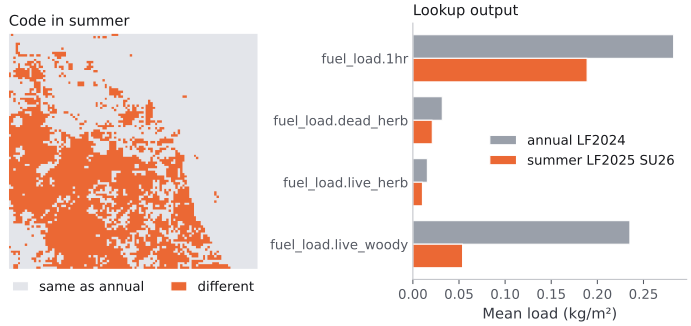
Annual LF2024 and summer LF2025 SU26 FBFM40 on the Santa Fe domain, over their
common extent, and the means of their lookups. 35.0% of cells have a
different code in summer, and 94% of those changed to a timber litter (TL)
model, mostly from SH7 and GS2. Mean fuel_load.live_woody falls from 0.235
to 0.054 kg/m², and mean fuel_load.1hr from 0.283 to 0.189 kg/m².
Fetch the summer classification
Section titled “Fetch the summer classification”The alignment object uses the annual grid as the target. Keep the two source grid ids separate: the lookup must point to the classification whose conditions you want.
curl -X 'POST' \ 'https://api.fastfuels.silvxlabs.com/v2/domains/your-domain-id/grids/fbfm40/landfire' \ -H 'accept: application/json' \ -H 'api-key: my-api-key' \ -H 'Content-Type: application/json' \ -d '{ "name": "Summer 2026 FBFM40 — LF2025 SU26", "version": "2025", "season": "SU", "alignment": { "target": "grid", "grid_id": "your-fbfm40-grid-id" }}'from fastfuels_sdk.v2.client_library.models import ( LandfireFbfm40Version, LandfireSeason,)
# A seasonal FBFM40 adds `season`; align it to the annual grid for comparison.summer = ff.grids.create_fuel_model_grid_from_landfire_fbfm40( domain, version=LandfireFbfm40Version("2025"), season=LandfireSeason.SU, align_to=annual, name="Summer 2026 FBFM40 — LF2025 SU26",)summer.wait(){ "id": "your-seasonal-fbfm40-grid-id", "domain_id": "your-domain-id", "name": "Summer 2026 FBFM40 — LF2025 SU26", "description": "", "status": "pending", "progress": null, "created_on": "2026-11-03T16:30:59.092137", "modified_on": "2026-11-03T16:30:59.092137", "checksum": "c7788209ddf24e27badf6b7eceb8a230", "source": { "name": "landfire", "product": "fbfm40", "version": "2025", "description": "LANDFIRE FBFM40 fuel model codes (Scott-Burgan 40 classification)", "extent_buffer_cells": 0, "alignment": { "target": "grid", "grid_id": "your-fbfm40-grid-id", "resolution": null, "method": null }, "disturbance": null, "remove_non_burnable": null, "boundary_scatter": null, "season": "SU", "year": 2026 }, "modifications": [], "bands": [ { "key": "fbfm", "name": "Scott & Burgan 40 Fuel Model", "description": "Scott & Burgan 40 fire behavior fuel model code (e.g. GR1, TL3, SH5). Convert to fuel parameters via /grids/lookup/fbfm40.", "type": "categorical", "unit": null, "index": 0, "nodata": null, "summary": null } ], "georeference": null, "error": null, "chunks": { "shape": [512, 512], "count": null, "count_by_axis": null }, "tags": []}{ "id": "your-seasonal-fbfm40-grid-id", "domain_id": "your-domain-id", "name": "Summer 2026 FBFM40 — LF2025 SU26", "description": "", "status": "completed", "progress": { "percent": 100, "message": "Complete" }, "created_on": "2026-11-03T16:30:59.092137Z", "modified_on": "2026-11-03T16:31:23.918035Z", "checksum": "c7788209ddf24e27badf6b7eceb8a230", "source": { "disturbance": null, "version": "2025", "name": "landfire", "product": "fbfm40", "description": "LANDFIRE FBFM40 fuel model codes (Scott-Burgan 40 classification)", "extent_buffer_cells": 0, "alignment": { "method": null, "target": "grid", "grid_id": "your-fbfm40-grid-id", "resolution": null }, "year": 2026, "remove_non_burnable": null, "season": "SU", "boundary_scatter": null }, "modifications": [], "bands": [ { "key": "fbfm", "name": "Scott & Burgan 40 Fuel Model", "description": "Scott & Burgan 40 fire behavior fuel model code (e.g. GR1, TL3, SH5). Convert to fuel parameters via /grids/lookup/fbfm40.", "type": "categorical", "unit": null, "index": 0, "nodata": -9999, "summary": { "type": "categorical", "count": 11336, "nodata_count": 0, "unique_count": 18 } } ], "georeference": { "crs": "EPSG:32613", "transform": [ 29.92571976224661, 0.0, 416700.0, 0.0, -29.925719762247844, 3948592.274855274 ], "shape": [104, 109] }, "error": null, "chunks": { "shape": [512, 512], "count": 1, "count_by_axis": { "y": 1, "x": 1 } }, "tags": []}Record the id as your-seasonal-fbfm40-grid-id. Inspect the completed
grid’s georeference before cell-by-cell comparison. In this example the
summer grid has one more row than the annual grid it was aligned to (shape
[104, 109] against [103, 109]).
Look up the summer parameters
Section titled “Look up the summer parameters”The lookup endpoint and band vocabulary do not change. Only source_grid_id
changes to the seasonal classification.
curl -X 'POST' \ 'https://api.fastfuels.silvxlabs.com/v2/domains/your-domain-id/grids/lookup/fbfm40' \ -H 'accept: application/json' \ -H 'api-key: my-api-key' \ -H 'Content-Type: application/json' \ -d '{ "name": "Summer 2026 FBFM40 surface parameters", "source_grid_id": "your-seasonal-fbfm40-grid-id", "source_band": "fbfm", "bands": [ "fuel_load.1hr", "fuel_load.dead_herb", "fuel_load.live_herb", "fuel_load.live_woody", "fuel_depth" ]}'summer_fuel = ff.grids.create_fuel_grid_from_fbfm40_lookup( summer, bands=[ "fuel_load.1hr", "fuel_load.dead_herb", "fuel_load.live_herb", "fuel_load.live_woody", "fuel_depth", ], name="Summer 2026 FBFM40 surface parameters",)summer_fuel.wait(){ "id": "your-seasonal-lookup-grid-id", "domain_id": "your-domain-id", "name": "Summer 2026 FBFM40 surface parameters", "description": "", "status": "pending", "progress": null, "created_on": "2026-11-03T16:31:25.679894", "modified_on": "2026-11-03T16:31:25.679894", "checksum": "35a7fdd519314e80a54b54665cde578c", "source": { "name": "lookup", "table": "fbfm40", "source_grid_id": "your-seasonal-fbfm40-grid-id", "source_grid_checksum": "c7788209ddf24e27badf6b7eceb8a230", "source_band": "fbfm", "herbaceous_curing": 0.67 }, "modifications": [], "bands": [ { "key": "fuel_load.1hr", "name": "1-hour Fuel Load", "description": "Oven-dry mass per unit area of 1-hour timelag dead fuels.", "type": "continuous", "unit": "kg/m**2", "index": 0, "nodata": null, "summary": null }, { "key": "fuel_load.dead_herb", "name": "Dead Herbaceous Fuel Load", "description": "Oven-dry mass per unit area of cured herbaceous fuels. Takes the dead 1-hour fuel moisture.", "type": "continuous", "unit": "kg/m**2", "index": 1, "nodata": null, "summary": null }, { "key": "fuel_load.live_herb", "name": "Live Herbaceous Fuel Load", "description": "Oven-dry mass per unit area of live herbaceous fuels: the uncured part of the herbaceous load.", "type": "continuous", "unit": "kg/m**2", "index": 2, "nodata": null, "summary": null }, { "key": "fuel_load.live_woody", "name": "Live Woody Fuel Load", "description": "Oven-dry mass per unit area of live woody fuels.", "type": "continuous", "unit": "kg/m**2", "index": 3, "nodata": null, "summary": null }, { "key": "fuel_depth", "name": "Fuel Bed Depth", "description": "Vertical depth of the surface fuel bed.", "type": "continuous", "unit": "m", "index": 4, "nodata": null, "summary": null } ], "georeference": { "crs": "EPSG:32613", "transform": [ 29.92571976224661, 0.0, 416700.0, 0.0, -29.925719762247844, 3948592.274855274 ], "shape": [104, 109] }, "error": null, "chunks": { "shape": [512, 512], "count": null, "count_by_axis": null }, "tags": []}{ "id": "your-seasonal-lookup-grid-id", "domain_id": "your-domain-id", "name": "Summer 2026 FBFM40 surface parameters", "description": "", "status": "completed", "progress": { "percent": 100, "message": "Complete" }, "created_on": "2026-11-03T16:31:25.679894Z", "modified_on": "2026-11-03T16:31:29.007782Z", "checksum": "35a7fdd519314e80a54b54665cde578c", "source": { "herbaceous_curing": 0.67, "source_grid_id": "your-seasonal-fbfm40-grid-id", "name": "lookup", "source_grid_checksum": "c7788209ddf24e27badf6b7eceb8a230", "source_band": "fbfm", "table": "fbfm40" }, "modifications": [], "bands": [ { "key": "fuel_load.1hr", "name": "1-hour Fuel Load", "description": "Oven-dry mass per unit area of 1-hour timelag dead fuels.", "type": "continuous", "unit": "kg/m**2", "index": 0, "nodata": null, "summary": { "type": "continuous", "count": 11336, "nodata_count": 0, "min": 0.0, "max": 1.3001821041107178, "mean": 0.1886850730589957, "std": 0.15075943780487017 } }, { "key": "fuel_load.dead_herb", "name": "Dead Herbaceous Fuel Load", "description": "Oven-dry mass per unit area of cured herbaceous fuels. Takes the dead 1-hour fuel moisture.", "type": "continuous", "unit": "kg/m**2", "index": 1, "nodata": null, "summary": { "type": "continuous", "count": 11336, "nodata_count": 0, "min": 0.0, "max": 0.2252901792526245, "mean": 0.021047090550085388, "std": 0.04082609574071622 } }, { "key": "fuel_load.live_herb", "name": "Live Herbaceous Fuel Load", "description": "Oven-dry mass per unit area of live herbaceous fuels: the uncured part of the herbaceous load.", "type": "continuous", "unit": "kg/m**2", "index": 2, "nodata": null, "summary": { "type": "continuous", "count": 11336, "nodata_count": 0, "min": 0.0, "max": 0.11096382141113281, "mean": 0.010366476021954184, "std": 0.020108373111578502 } }, { "key": "fuel_load.live_woody", "name": "Live Woody Fuel Load", "description": "Oven-dry mass per unit area of live woody fuels.", "type": "continuous", "unit": "kg/m**2", "index": 3, "nodata": null, "summary": { "type": "continuous", "count": 11336, "nodata_count": 0, "min": 0.0, "max": 0.7621757388114929, "mean": 0.0538789476859518, "std": 0.1127292409020954 } }, { "key": "fuel_depth", "name": "Fuel Bed Depth", "description": "Vertical depth of the surface fuel bed.", "type": "continuous", "unit": "m", "index": 4, "nodata": null, "summary": { "type": "continuous", "count": 11336, "nodata_count": 0, "min": 0.0, "max": 1.8287999629974365, "mean": 0.19542315892872567, "std": 0.18372216630547428 } } ], "georeference": { "crs": "EPSG:32613", "transform": [ 29.92571976224661, 0.0, 416700.0, 0.0, -29.925719762247844, 3948592.274855274 ], "shape": [104, 109] }, "error": null, "chunks": { "shape": [512, 512], "count": 1, "count_by_axis": { "y": 1, "x": 1 } }, "tags": []}Record the result as your-seasonal-lookup-grid-id.
Build an FBFM13 grid
Section titled “Build an FBFM13 grid”FBFM13 follows the same fetch-then-lookup pattern, but its categorical band is
fbfm13 and its parameter vocabulary includes fuel_load.live_foliage rather
than FBFM40’s separate live herbaceous and woody loads. Seasonal layers are not
available for FBFM13.
curl -X 'POST' \ 'https://api.fastfuels.silvxlabs.com/v2/domains/your-domain-id/grids/fbfm13/landfire' \ -H 'accept: application/json' \ -H 'api-key: my-api-key' \ -H 'Content-Type: application/json' \ -d '{ "name": "Annual FBFM13 — LF2024", "version": "2024"}'from fastfuels_sdk.v2.client_library.models import LandfireFbfm13Version
fbfm13 = ff.grids.create_fuel_model_grid_from_landfire_fbfm13( domain, version=LandfireFbfm13Version("2024"), name="Annual FBFM13 — LF2024",)fbfm13.wait(){ "id": "your-fbfm13-grid-id", "domain_id": "your-domain-id", "name": "Annual FBFM13 — LF2024", "description": "", "status": "pending", "progress": null, "created_on": "2026-11-03T16:31:31.161978", "modified_on": "2026-11-03T16:31:31.161978", "checksum": "b8eb67c38b454de9bb5292e17edea747", "source": { "name": "landfire", "product": "fbfm13", "version": "2024", "description": "LANDFIRE FBFM13 fuel model codes (Anderson 13 classification)", "extent_buffer_cells": 0, "alignment": { "target": "domain", "resolution": null, "method": null }, "disturbance": null, "remove_non_burnable": null, "boundary_scatter": null }, "modifications": [], "bands": [ { "key": "fbfm13", "name": "Anderson 13 Fuel Model", "description": "Anderson 13 fire behavior fuel model code (1-13). Convert to fuel parameters via /grids/lookup/fbfm13.", "type": "categorical", "unit": null, "index": 0, "nodata": null, "summary": null } ], "georeference": null, "error": null, "chunks": { "shape": [512, 512], "count": null, "count_by_axis": null }, "tags": []}{ "id": "your-fbfm13-grid-id", "domain_id": "your-domain-id", "name": "Annual FBFM13 — LF2024", "description": "", "status": "completed", "progress": { "percent": 100, "message": "Complete" }, "created_on": "2026-11-03T16:31:31.161978Z", "modified_on": "2026-11-03T16:31:33.765372Z", "checksum": "b8eb67c38b454de9bb5292e17edea747", "source": { "disturbance": null, "version": "2024", "name": "landfire", "product": "fbfm13", "description": "LANDFIRE FBFM13 fuel model codes (Anderson 13 classification)", "extent_buffer_cells": 0, "alignment": { "method": null, "target": "domain", "resolution": null }, "remove_non_burnable": null, "boundary_scatter": null }, "modifications": [], "bands": [ { "key": "fbfm13", "name": "Anderson 13 Fuel Model", "description": "Anderson 13 fire behavior fuel model code (1-13). Convert to fuel parameters via /grids/lookup/fbfm13.", "type": "categorical", "unit": null, "index": 0, "nodata": 32767, "summary": { "type": "categorical", "count": 11227, "nodata_count": 0, "unique_count": 10 } } ], "georeference": { "crs": "EPSG:32613", "transform": [ 29.92571976224661, 0.0, 416700.0, 0.0, -29.925719762248104, 3948562.3491355116 ], "shape": [103, 109] }, "error": null, "chunks": { "shape": [512, 512], "count": 1, "count_by_axis": { "y": 1, "x": 1 } }, "tags": []}Poll the classification, save its id as your-fbfm13-grid-id, then run the FBFM13 lookup:
curl -X 'POST' \ 'https://api.fastfuels.silvxlabs.com/v2/domains/your-domain-id/grids/lookup/fbfm13' \ -H 'accept: application/json' \ -H 'api-key: my-api-key' \ -H 'Content-Type: application/json' \ -d '{ "name": "FBFM13 surface parameters", "source_grid_id": "your-fbfm13-grid-id", "source_band": "fbfm13", "bands": [ "fuel_load.1hr", "fuel_load.10hr", "fuel_load.100hr", "fuel_load.live_foliage", "savr.1hr", "fuel_depth" ]}'fbfm13_fuel = ff.grids.create_fuel_grid_from_fbfm13_lookup( fbfm13, bands=[ "fuel_load.1hr", "fuel_load.10hr", "fuel_load.100hr", "fuel_load.live_foliage", "savr.1hr", "fuel_depth", ], name="FBFM13 surface parameters",)fbfm13_fuel.wait(){ "id": "your-fbfm13-lookup-grid-id", "domain_id": "your-domain-id", "name": "FBFM13 surface parameters", "description": "", "status": "pending", "progress": null, "created_on": "2026-11-03T16:31:36.684444", "modified_on": "2026-11-03T16:31:36.684444", "checksum": "3c99b9e8fdf64581b79c3c312b815173", "source": { "name": "lookup", "table": "fbfm13", "source_grid_id": "your-fbfm13-grid-id", "source_grid_checksum": "b8eb67c38b454de9bb5292e17edea747", "source_band": "fbfm13" }, "modifications": [], "bands": [ { "key": "fuel_load.1hr", "name": "1-hour Fuel Load", "description": "Oven-dry mass per unit area of 1-hour timelag dead fuels.", "type": "continuous", "unit": "kg/m**2", "index": 0, "nodata": null, "summary": null }, { "key": "fuel_load.10hr", "name": "10-hour Fuel Load", "description": "Oven-dry mass per unit area of 10-hour timelag dead fuels.", "type": "continuous", "unit": "kg/m**2", "index": 1, "nodata": null, "summary": null }, { "key": "fuel_load.100hr", "name": "100-hour Fuel Load", "description": "Oven-dry mass per unit area of 100-hour timelag dead fuels.", "type": "continuous", "unit": "kg/m**2", "index": 2, "nodata": null, "summary": null }, { "key": "fuel_load.live_foliage", "name": "Live Foliage Fuel Load", "description": "Oven-dry mass per unit area of live foliage fuels.", "type": "continuous", "unit": "kg/m**2", "index": 3, "nodata": null, "summary": null }, { "key": "savr.1hr", "name": "1-hour Surface-Area-to-Volume Ratio", "description": "Surface-area-to-volume ratio of 1-hour timelag dead fuels.", "type": "continuous", "unit": "1/m", "index": 4, "nodata": null, "summary": null }, { "key": "fuel_depth", "name": "Fuel Bed Depth", "description": "Vertical depth of the surface fuel bed.", "type": "continuous", "unit": "m", "index": 5, "nodata": null, "summary": null } ], "georeference": { "crs": "EPSG:32613", "transform": [ 29.92571976224661, 0.0, 416700.0, 0.0, -29.925719762248104, 3948562.3491355116 ], "shape": [103, 109] }, "error": null, "chunks": { "shape": [512, 512], "count": null, "count_by_axis": null }, "tags": []}{ "id": "your-fbfm13-lookup-grid-id", "domain_id": "your-domain-id", "name": "FBFM13 surface parameters", "description": "", "status": "completed", "progress": { "percent": 100, "message": "Complete" }, "created_on": "2026-11-03T16:31:36.684444Z", "modified_on": "2026-11-03T16:31:40.325603Z", "checksum": "3c99b9e8fdf64581b79c3c312b815173", "source": { "source_grid_id": "your-fbfm13-grid-id", "name": "lookup", "source_grid_checksum": "b8eb67c38b454de9bb5292e17edea747", "source_band": "fbfm13", "table": "fbfm13" }, "modifications": [], "bands": [ { "key": "fuel_load.1hr", "name": "1-hour Fuel Load", "description": "Oven-dry mass per unit area of 1-hour timelag dead fuels.", "type": "continuous", "unit": "kg/m**2", "index": 0, "nodata": null, "summary": { "type": "continuous", "count": 11227, "nodata_count": 0, "min": 0.0, "max": 1.1230883598327637, "mean": 0.3324958127172163, "std": 0.20341264526641092 } }, { "key": "fuel_load.10hr", "name": "10-hour Fuel Load", "description": "Oven-dry mass per unit area of 10-hour timelag dead fuels.", "type": "continuous", "unit": "kg/m**2", "index": 1, "nodata": null, "summary": { "type": "continuous", "count": 11227, "nodata_count": 0, "min": 0.0, "max": 0.8989190459251404, "mean": 0.19773942973473688, "std": 0.1906930789670611 } }, { "key": "fuel_load.100hr", "name": "100-hour Fuel Load", "description": "Oven-dry mass per unit area of 100-hour timelag dead fuels.", "type": "continuous", "unit": "kg/m**2", "index": 2, "nodata": null, "summary": { "type": "continuous", "count": 11227, "nodata_count": 0, "min": 0.0, "max": 1.1230883598327637, "mean": 0.16114514126711393, "std": 0.23477466697174199 } }, { "key": "fuel_load.live_foliage", "name": "Live Foliage Fuel Load", "description": "Oven-dry mass per unit area of live foliage fuels.", "type": "continuous", "unit": "kg/m**2", "index": 3, "nodata": null, "summary": { "type": "continuous", "count": 11227, "nodata_count": 0, "min": 0.0, "max": 1.1230883598327637, "mean": 0.1614138969407116, "std": 0.2153653120876737 } }, { "key": "savr.1hr", "name": "1-hour Surface-Area-to-Volume Ratio", "description": "Surface-area-to-volume ratio of 1-hour timelag dead fuels.", "type": "continuous", "unit": "1/m", "index": 4, "nodata": null, "summary": { "type": "continuous", "count": 11227, "nodata_count": 0, "min": 0.0, "max": 9842.51953125, "mean": 6019.08599551792, "std": 2348.0657644205244 } }, { "key": "fuel_depth", "name": "Fuel Bed Depth", "description": "Vertical depth of the surface fuel bed.", "type": "continuous", "unit": "m", "index": 5, "nodata": null, "summary": { "type": "continuous", "count": 11227, "nodata_count": 0, "min": 0.0, "max": 1.8287999629974365, "mean": 0.38826367970902104, "std": 0.3125352642042458 } } ], "georeference": { "crs": "EPSG:32613", "transform": [ 29.92571976224661, 0.0, 416700.0, 0.0, -29.925719762248104, 3948562.3491355116 ], "shape": [103, 109] }, "error": null, "chunks": { "shape": [512, 512], "count": 1, "count_by_axis": { "y": 1, "x": 1 } }, "tags": []}Record the result as your-fbfm13-lookup-grid-id.
Build an FCCS grid
Section titled “Build an FCCS grid”FCCS uses fuelbed identifiers and exposes a different set of physical
components — litter, duff, live shrub, and live herbaceous load rather than
the timelag-based bands of the FBFM products. Like FBFM13, FCCS has no
seasonal layers. remove_bare_ground controls whether bare-ground fuelbeds
are removed during the fetch.
curl -X 'POST' \ 'https://api.fastfuels.silvxlabs.com/v2/domains/your-domain-id/grids/fccs/landfire' \ -H 'accept: application/json' \ -H 'api-key: my-api-key' \ -H 'Content-Type: application/json' \ -d '{ "name": "FCCS fuelbeds — LF2023", "version": "2023", "remove_bare_ground": false}'from fastfuels_sdk.v2.client_library.models import LandfireFccsVersion
fccs = ff.grids.create_fuel_model_grid_from_landfire_fccs( domain, version=LandfireFccsVersion("2023"), remove_bare_ground=False, name="FCCS fuelbeds — LF2023",)fccs.wait(){ "id": "your-fccs-grid-id", "domain_id": "your-domain-id", "name": "FCCS fuelbeds — LF2023", "description": "", "status": "pending", "progress": null, "created_on": "2026-11-03T16:31:42.231000", "modified_on": "2026-11-03T16:31:42.231000", "checksum": "3279b57616f1492a96d39694f5d280c8", "source": { "name": "landfire", "product": "fccs", "version": "2023", "description": "LANDFIRE FCCS fuelbed IDs", "extent_buffer_cells": 0, "alignment": { "target": "domain", "resolution": null, "method": null }, "disturbance": null, "remove_bare_ground": false, "boundary_scatter": null }, "modifications": [], "bands": [ { "key": "fccs", "name": "FCCS Fuelbed ID", "description": "Fuel Characteristic Classification System (FCCS) fuelbed identifier. Convert to fuel parameters via /grids/lookup/fccs.", "type": "categorical", "unit": null, "index": 0, "nodata": null, "summary": null } ], "georeference": null, "error": null, "chunks": { "shape": [512, 512], "count": null, "count_by_axis": null }, "tags": []}{ "id": "your-fccs-grid-id", "domain_id": "your-domain-id", "name": "FCCS fuelbeds — LF2023", "description": "", "status": "completed", "progress": { "percent": 100, "message": "Complete" }, "created_on": "2026-11-03T16:31:42.231000Z", "modified_on": "2026-11-03T16:31:44.712035Z", "checksum": "3279b57616f1492a96d39694f5d280c8", "source": { "disturbance": null, "remove_bare_ground": false, "version": "2023", "name": "landfire", "product": "fccs", "description": "LANDFIRE FCCS fuelbed IDs", "extent_buffer_cells": 0, "alignment": { "method": null, "target": "domain", "resolution": null }, "boundary_scatter": null }, "modifications": [], "bands": [ { "key": "fccs", "name": "FCCS Fuelbed ID", "description": "Fuel Characteristic Classification System (FCCS) fuelbed identifier. Convert to fuel parameters via /grids/lookup/fccs.", "type": "categorical", "unit": null, "index": 0, "nodata": 2147483647, "summary": { "type": "categorical", "count": 11227, "nodata_count": 0, "unique_count": 34 } } ], "georeference": { "crs": "EPSG:32613", "transform": [ 29.92571976224661, 0.0, 416700.0, 0.0, -29.925719762248104, 3948562.3491355116 ], "shape": [103, 109] }, "error": null, "chunks": { "shape": [512, 512], "count": 1, "count_by_axis": { "y": 1, "x": 1 } }, "tags": []}Poll the classification, save its id as your-fccs-grid-id, then use
the FCCS lookup and its fccs source band:
curl -X 'POST' \ 'https://api.fastfuels.silvxlabs.com/v2/domains/your-domain-id/grids/lookup/fccs' \ -H 'accept: application/json' \ -H 'api-key: my-api-key' \ -H 'Content-Type: application/json' \ -d '{ "name": "FCCS surface parameters", "source_grid_id": "your-fccs-grid-id", "source_band": "fccs", "bands": [ "fuel_load.litter", "fuel_load.duff", "duff_depth", "fuel_load.live_shrub", "fuel_load.live_herb", "fuel_load.1hr" ]}'fccs_fuel = ff.grids.create_fuel_grid_from_fccs_lookup( fccs, bands=[ "fuel_load.litter", "fuel_load.duff", "duff_depth", "fuel_load.live_shrub", "fuel_load.live_herb", "fuel_load.1hr", ], name="FCCS surface parameters",)fccs_fuel.wait(){ "id": "your-fccs-lookup-grid-id", "domain_id": "your-domain-id", "name": "FCCS surface parameters", "description": "", "status": "pending", "progress": null, "created_on": "2026-11-03T16:31:47.671372", "modified_on": "2026-11-03T16:31:47.671372", "checksum": "78374636244e41139e8206d6c295bc2d", "source": { "name": "lookup", "table": "fccs", "source_grid_id": "your-fccs-grid-id", "source_grid_checksum": "3279b57616f1492a96d39694f5d280c8", "source_band": "fccs" }, "modifications": [], "bands": [ { "key": "fuel_load.litter", "name": "Litter Fuel Load", "description": "Oven-dry mass per unit area of the litter layer.", "type": "continuous", "unit": "kg/m**2", "index": 0, "nodata": null, "summary": null }, { "key": "fuel_load.duff", "name": "Duff Fuel Load", "description": "Oven-dry mass per unit area of the duff layer.", "type": "continuous", "unit": "kg/m**2", "index": 1, "nodata": null, "summary": null }, { "key": "duff_depth", "name": "Duff Layer Depth", "description": "Vertical depth of the duff layer.", "type": "continuous", "unit": "m", "index": 2, "nodata": null, "summary": null }, { "key": "fuel_load.live_shrub", "name": "Live Shrub Fuel Load", "description": "Oven-dry mass per unit area of live shrub fuels.", "type": "continuous", "unit": "kg/m**2", "index": 3, "nodata": null, "summary": null }, { "key": "fuel_load.live_herb", "name": "Live Herbaceous Fuel Load", "description": "Oven-dry mass per unit area of live herbaceous fuels.", "type": "continuous", "unit": "kg/m**2", "index": 4, "nodata": null, "summary": null }, { "key": "fuel_load.1hr", "name": "1-hour Fuel Load", "description": "Oven-dry mass per unit area of 1-hour timelag dead fuels.", "type": "continuous", "unit": "kg/m**2", "index": 5, "nodata": null, "summary": null } ], "georeference": { "crs": "EPSG:32613", "transform": [ 29.92571976224661, 0.0, 416700.0, 0.0, -29.925719762248104, 3948562.3491355116 ], "shape": [103, 109] }, "error": null, "chunks": { "shape": [512, 512], "count": null, "count_by_axis": null }, "tags": []}{ "id": "your-fccs-lookup-grid-id", "domain_id": "your-domain-id", "name": "FCCS surface parameters", "description": "", "status": "completed", "progress": { "percent": 100, "message": "Complete" }, "created_on": "2026-11-03T16:31:47.671372Z", "modified_on": "2026-11-03T16:31:51.802068Z", "checksum": "78374636244e41139e8206d6c295bc2d", "source": { "source_grid_id": "your-fccs-grid-id", "name": "lookup", "source_grid_checksum": "3279b57616f1492a96d39694f5d280c8", "source_band": "fccs", "table": "fccs" }, "modifications": [], "bands": [ { "key": "fuel_load.litter", "name": "Litter Fuel Load", "description": "Oven-dry mass per unit area of the litter layer.", "type": "continuous", "unit": "kg/m**2", "index": 0, "nodata": null, "summary": { "type": "continuous", "count": 11227, "nodata_count": 0, "min": 0.0, "max": 0.3990213871002197, "mean": 0.13599093264581688, "std": 0.09801640019370758 } }, { "key": "fuel_load.duff", "name": "Duff Fuel Load", "description": "Oven-dry mass per unit area of the duff layer.", "type": "continuous", "unit": "kg/m**2", "index": 1, "nodata": null, "summary": { "type": "continuous", "count": 11227, "nodata_count": 0, "min": 0.0, "max": 2.6900320053100586, "mean": 0.32078356955306947, "std": 0.41629612575548464 } }, { "key": "duff_depth", "name": "Duff Layer Depth", "description": "Vertical depth of the duff layer.", "type": "continuous", "unit": "m", "index": 2, "nodata": null, "summary": { "type": "continuous", "count": 11227, "nodata_count": 0, "min": 0.0, "max": 0.05079999938607216, "mean": 0.00843774580213052, "std": 0.007855024235531189 } }, { "key": "fuel_load.live_shrub", "name": "Live Shrub Fuel Load", "description": "Oven-dry mass per unit area of live shrub fuels.", "type": "continuous", "unit": "kg/m**2", "index": 3, "nodata": null, "summary": { "type": "continuous", "count": 11227, "nodata_count": 0, "min": 0.0, "max": 1.291215419769287, "mean": 0.3402619584686434, "std": 0.22607215857984334 } }, { "key": "fuel_load.live_herb", "name": "Live Herbaceous Fuel Load", "description": "Oven-dry mass per unit area of live herbaceous fuels.", "type": "continuous", "unit": "kg/m**2", "index": 4, "nodata": null, "summary": { "type": "continuous", "count": 11227, "nodata_count": 0, "min": 0.0, "max": 0.9841033220291138, "mean": 0.033774552226371525, "std": 0.033838478830644635 } }, { "key": "fuel_load.1hr", "name": "1-hour Fuel Load", "description": "Oven-dry mass per unit area of 1-hour timelag dead fuels.", "type": "continuous", "unit": "kg/m**2", "index": 5, "nodata": null, "summary": { "type": "continuous", "count": 11227, "nodata_count": 0, "min": 0.0, "max": 0.11208466440439224, "mean": 0.03188208143888027, "std": 0.017489461439320904 } } ], "georeference": { "crs": "EPSG:32613", "transform": [ 29.92571976224661, 0.0, 416700.0, 0.0, -29.925719762248104, 3948562.3491355116 ], "shape": [103, 109] }, "error": null, "chunks": { "shape": [512, 512], "count": 1, "count_by_axis": { "y": 1, "x": 1 } }, "tags": []}Record the result as your-fccs-lookup-grid-id.
FBFM40, FBFM13, and FCCS accept different lookup band names. Do not reuse a band list across products without checking it.
Scatter category boundaries
Section titled “Scatter category boundaries”LANDFIRE classifies fuels on a 30 m grid. When the output resolution is finer
than 30 m, nearest-neighbor resampling copies each 30 m code into a block of
identical cells, producing staircase edges between fuel model categories.
boundary_scatter replaces those edges by probabilistically mixing codes at
category boundaries.
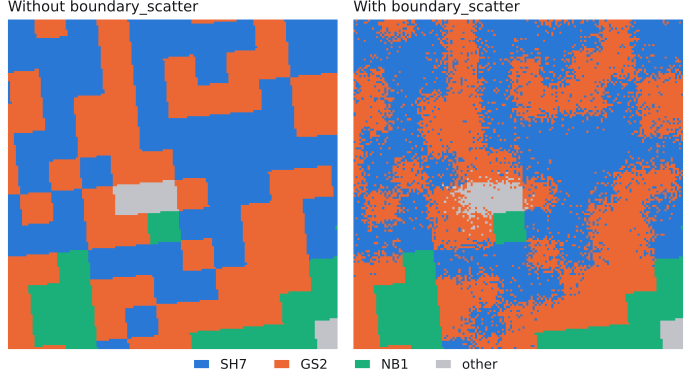
A 320 × 320 m detail of the 2 m FBFM40 grid on the Santa Fe domain, without
and with boundary_scatter. Without scatter, each 30 m source cell becomes a
block of about 15 × 15 cells with staircase edges. With scatter, GS2 and SH7
codes mix across their boundaries. The NB1 cells are the same in both grids.
Across the whole grid, 10.6% of cells have a different code with scatter.
Add boundary_scatter to any FBFM40, FBFM13, or FCCS create request.
Pass {} for the defaults (depth 10, seed 42), or set them explicitly:
| Parameter | Default | Meaning |
|---|---|---|
depth | 10 | How many cells deep scattering can reach (1–50). |
seed | 42 | Random seed for reproducible results. |
curl -X 'POST' \ 'https://api.fastfuels.silvxlabs.com/v2/domains/your-domain-id/grids/fbfm40/landfire' \ -H 'accept: application/json' \ -H 'api-key: my-api-key' \ -H 'Content-Type: application/json' \ -d '{ "name": "FBFM40 — LF2024, 2 m scatter", "version": "2024", "alignment": { "target": "domain", "resolution": 2.0 }, "boundary_scatter": {}}'scatter = ff.grids.create_fuel_model_grid_from_landfire_fbfm40( domain, version=LandfireFbfm40Version("2024"), output_resolution_m=2.0, boundary_scatter=True, name="FBFM40 — LF2024, 2 m scatter",)scatter.wait(){ "id": "your-fbfm40-grid-id", "domain_id": "your-domain-id", "name": "FBFM40 — LF2024, 2 m scatter", "description": "", "status": "pending", "progress": null, "created_on": "2026-11-03T16:31:53.119398", "modified_on": "2026-11-03T16:31:53.119398", "checksum": "ceb4b96ee4e54c309535d4f1ac744beb", "source": { "name": "landfire", "product": "fbfm40", "version": "2024", "description": "LANDFIRE FBFM40 fuel model codes (Scott-Burgan 40 classification)", "extent_buffer_cells": 0, "alignment": { "target": "domain", "resolution": 2.0, "method": null }, "disturbance": null, "remove_non_burnable": null, "boundary_scatter": { "depth": 10, "seed": 42 }, "season": null, "year": 2024 }, "modifications": [], "bands": [ { "key": "fbfm", "name": "Scott & Burgan 40 Fuel Model", "description": "Scott & Burgan 40 fire behavior fuel model code (e.g. GR1, TL3, SH5). Convert to fuel parameters via /grids/lookup/fbfm40.", "type": "categorical", "unit": null, "index": 0, "nodata": null, "summary": null } ], "georeference": null, "error": null, "chunks": { "shape": [512, 512], "count": null, "count_by_axis": null }, "tags": []}{ "id": "your-fbfm40-grid-id", "domain_id": "your-domain-id", "name": "FBFM40 — LF2024, 2 m scatter", "description": "", "status": "completed", "progress": { "percent": 100, "message": "Complete" }, "created_on": "2026-11-03T16:31:53.119398Z", "modified_on": "2026-11-03T16:31:56.566474Z", "checksum": "ceb4b96ee4e54c309535d4f1ac744beb", "source": { "disturbance": null, "version": "2024", "name": "landfire", "product": "fbfm40", "description": "LANDFIRE FBFM40 fuel model codes (Scott-Burgan 40 classification)", "extent_buffer_cells": 0, "alignment": { "method": null, "target": "domain", "resolution": 2.0 }, "year": 2024, "remove_non_burnable": null, "season": null, "boundary_scatter": { "seed": 42, "depth": 10 } }, "modifications": [], "bands": [ { "key": "fbfm", "name": "Scott & Burgan 40 Fuel Model", "description": "Scott & Burgan 40 fire behavior fuel model code (e.g. GR1, TL3, SH5). Convert to fuel parameters via /grids/lookup/fbfm40.", "type": "categorical", "unit": null, "index": 0, "nodata": 32767, "summary": { "type": "categorical", "count": 2478600, "nodata_count": 0, "unique_count": 17 } } ], "georeference": { "crs": "EPSG:32613", "transform": [2.0, 0.0, 416700.0, 0.0, -2.0, 3948540.0], "shape": [1530, 1620] }, "error": null, "chunks": { "shape": [512, 512], "count": 12, "count_by_axis": { "y": 3, "x": 4 } }, "tags": []}The response records boundary_scatter in source with the resolved
defaults. Downstream lookups work identically — point the lookup at this
classification the same way you would point it at a native-resolution one.
Check what’s available for your domain
Section titled “Check what’s available for your domain”Each product has a coverage check that lists every version and season the API can serve for your domain, reports whether each one fully covers it, and identifies the latest release. Run it before choosing a version, especially for seasonal requests or domains near the edge of a LANDFIRE region.
curl -X 'GET' \ 'https://api.fastfuels.silvxlabs.com/v2/domains/your-domain-id/grids/fbfm40/landfire/coverage' \ -H 'accept: application/json' \ -H 'api-key: my-api-key'import fastfuels_sdk.v2 as ff
ff.set_api_key("my-api-key")
domain = ff.Domain.from_id("your-domain-id")
coverage = ff.grids.check_landfire_fbfm40_coverage(domain)print(f"Latest: {coverage.latest}")print(f"Releases: {len(coverage.releases)}")for release in coverage.releases: print(f" {release.version} {release.season or 'annual':>7} " f"year={release.year} coverage={release.coverage}"){ "product": "fbfm40", "latest": { "version": "2025", "season": "FA", "year": 2026, "coverage": "full", "links": { "create": { "href": "/v2/domains/your-domain-id/grids/fbfm40/landfire", "method": "POST", "body": { "version": "2025", "season": "FA" } } } }, "releases": [ { "version": "2025", "season": "FA", "year": 2026, "coverage": "full", "links": { "create": { "href": "/v2/domains/your-domain-id/grids/fbfm40/landfire", "method": "POST", "body": { "version": "2025", "season": "FA" } } } }, { "version": "2025", "season": "SU", "year": 2026, "coverage": "full", "links": { "create": { "href": "/v2/domains/your-domain-id/grids/fbfm40/landfire", "method": "POST", "body": { "version": "2025", "season": "SU" } } } }, { "version": "2025", "season": "SP", "year": 2026, "coverage": "full", "links": { "create": { "href": "/v2/domains/your-domain-id/grids/fbfm40/landfire", "method": "POST", "body": { "version": "2025", "season": "SP" } } } }, { "version": "2025", "season": "ES", "year": 2026, "coverage": "full", "links": { "create": { "href": "/v2/domains/your-domain-id/grids/fbfm40/landfire", "method": "POST", "body": { "version": "2025", "season": "ES" } } } }, { "version": "2025", "season": null, "year": 2025, "coverage": "full", "links": { "create": { "href": "/v2/domains/your-domain-id/grids/fbfm40/landfire", "method": "POST", "body": { "version": "2025" } } } }, { "version": "2024", "season": null, "year": 2024, "coverage": "full", "links": { "create": { "href": "/v2/domains/your-domain-id/grids/fbfm40/landfire", "method": "POST", "body": { "version": "2024" } } } }, { "version": "2023", "season": null, "year": 2023, "coverage": "full", "links": { "create": { "href": "/v2/domains/your-domain-id/grids/fbfm40/landfire", "method": "POST", "body": { "version": "2023" } } } }, { "version": "2022", "season": null, "year": 2022, "coverage": "full", "links": { "create": { "href": "/v2/domains/your-domain-id/grids/fbfm40/landfire", "method": "POST", "body": { "version": "2022" } } } }, { "version": "2020", "season": null, "year": 2020, "coverage": "full", "links": { "create": { "href": "/v2/domains/your-domain-id/grids/fbfm40/landfire", "method": "POST", "body": { "version": "2020" } } } }, { "version": "2019", "season": null, "year": 2019, "coverage": "full", "links": { "create": { "href": "/v2/domains/your-domain-id/grids/fbfm40/landfire", "method": "POST", "body": { "version": "2019" } } } } ]}The releases array is sorted newest first. Each entry reports:
coverage: "full"— the version fully covers the domain and can be created.links.createcontains the ready-made request: POST itsbodyto itshref, the endpoint’s path onhttps://api.fastfuels.silvxlabs.com.coverage: "partial"— the domain straddles a LANDFIRE region boundary. The create succeeds, but cells outside the served area are nodata.coverage: "none"— LANDFIRE serves this release in other regions but not here.links.createisnull.coverage: "unpublished"— the season has not been published anywhere yet.yearisnull.
latest is the most recent release that fully covers the domain, whether
annual or seasonal. In this example the domain is in the Southwest, where
LANDFIRE has published seasonal fuels through fall 2026, so latest is
LF2025 FA. A domain in a region where seasonal coverage has not rolled out
would show an annual vintage as latest instead.
FBFM13 and FCCS have the same check at their own paths
(/grids/fbfm13/landfire/coverage and /grids/fccs/landfire/coverage). Neither
product has seasonal entries.
Inspect and prepare the result
Section titled “Inspect and prepare the result”The lookup grid is the continuous surface-fuel product. The source classification remains useful for auditing which code produced each value.
- Fetch grid data to inspect values and summaries.
- Remove surface fuel under roads, water and buildings when those features should be non-burnable in your use case.
- Resample a grid when a downstream model requires a different resolution or lattice.
- Compute dead fuel moisture from a surface-fuel grid and weather conditions using the Fosberg model.
- Create QUIC-Fire simulation inputs to align the complete landscape and export its physical bands.
- Set up a QUIC-Fire simulation after downloading the export.
- Read About surface fuels for the relationship among classifications, lookup parameters, and modeled fuels.
Common pitfalls
Section titled “Common pitfalls”- Treating category codes as physical values. Run the lookup before using loads, depths, or SAVR in a model.
- Using
fuel_load.1hras the only dead surface load. It leaves out cured herbaceous fuel. Usefuel_load.fine_deadandsavr.fine_deadfor a single fine dead class. - Comparing
fuel_load.live_herbalone with Scott and Burgan’s Table 7. Comparefuel_load.live_herbplusfuel_load.dead_herbwith the table’s herbaceous load (why). - Using the wrong source band. Use
fbfmfor FBFM40,fbfm13for FBFM13, andfccsfor FCCS. - Running a lookup before the classification completes. Poll the fetch to
completed. The lookup reads its stored cell values. - Assuming a season or vintage is available everywhere. Run the
coverage check first. A domain
with full annual coverage may still report
nonefor a given season, and on-demand vintages roll out region by region. - Confusing vintage and represented year.
source.versionis the landscape vintage (the generation of LANDFIRE data).source.yearis the calendar year the data represents. They match for annual products but diverge for seasonal layers. - Comparing grids without checking georeferencing. Compare
crs,transform, andshape. Crop or resample to a common footprint when needed. - Treating resampling as added detail. Resampling a LANDFIRE grid to smaller cells changes its lattice, not the information content of the source product.
- Applying boundary scatter at native resolution. Scatter has no effect
when the output resolution matches the source (30 m). Set
alignment.resolutionto a finer grid before enabling it.